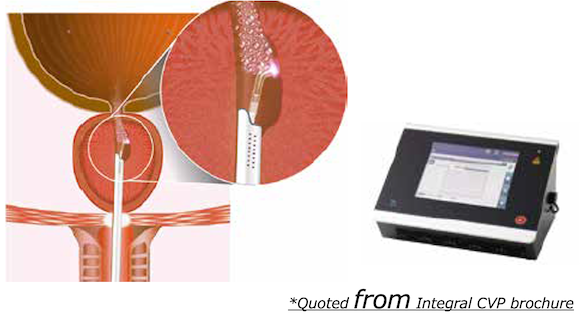





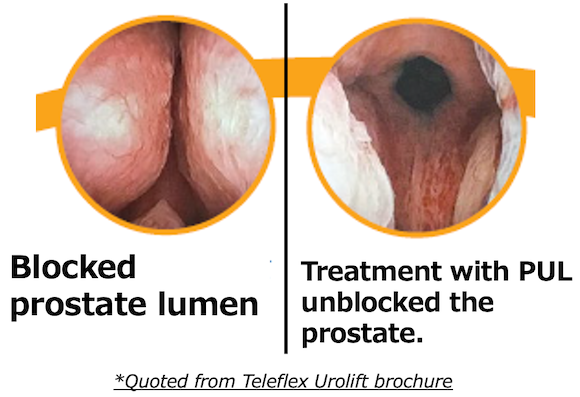
Prostatic Urethral Lift (PUL: UroLift)
The procedure usually takes about 30 minutes, depending on the size of the prostate (up to approximately 80 mL).
Because it is minimally invasive, it may be selected for elderly patients and others who prefer a lower physical burden.
Bleeding is usually minimal, although blood in the urine may occur after discharge. In most cases, urinary urgency and hematuria improve within about one month after surgery.
To confirm the absence of prostate cancer, MRI examinations and prostate biopsy may be recommended in advance. Currently, only limited cases are suitable for this treatment (not indicated for median lobe enlargement), and the attending physician will recommend the most appropriate option.
TUL: Transurethral Ureteroscopic Lithotripsy
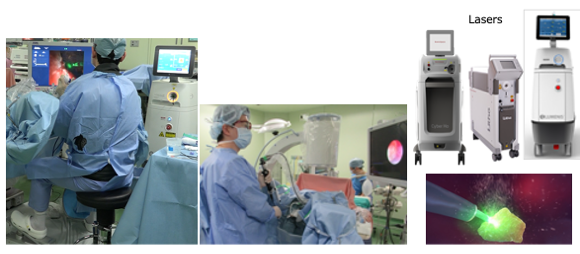
This procedure is used for stones up to approximately 2 cm in size. A 3 mm ureteroscope is inserted through the urethra, and the stones are fragmented and removed using a laser.
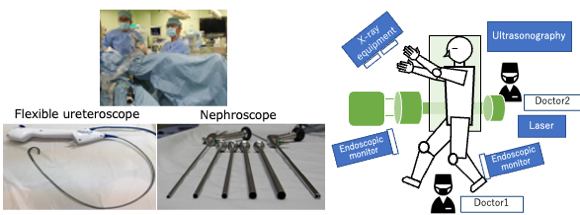
ECIRS: Endoscopic Combined Intrarenal Surgery
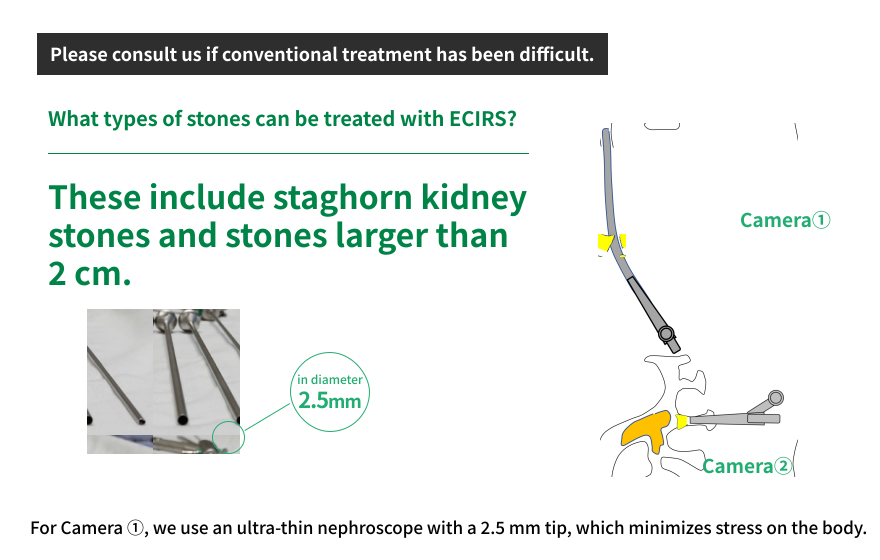
This procedure is used for stones larger than 3 cm. A 3 mm ureteroscope is inserted through the urethra, while another camera (nephroscope) is inserted through the kidney, allowing stones to be fragmented and removed using a laser.
*Because a catheter remains in the kidney for several days, hospitalization is generally longer compared with TUL.
HoLEP: Holmium Laser Enucleation of the Prostate
The procedure usually takes about 1–2 hours, depending on the size of the prostate. In physically fit patients, prostates larger than 200 mL may also be treated.
Bleeding volume and operating time vary according to prostate size. Blood transfusion is generally not required.
To confirm the absence of prostate cancer, MRI examinations and prostate biopsy may be recommended in advance. After surgery, patients will receive lifestyle guidance for approximately one month, such as avoiding abdominal strain and strenuous exercise, to promote faster recovery.
The attending physician will recommend whether HoLEP or CVP is the more appropriate treatment option.
Laser Vaporization Therapy (CVP)
Contact Laser Vaporization of the Prostate (CVP) is a surgical procedure in which an optical fiber is placed directly against prostate tissue and laser energy is applied to vaporize enlarged tissue, rapidly reducing prostate volume.
The procedure usually takes less than one hour, depending on the size of the prostate.
Bleeding is minimal. Because a thin endoscope is used, the procedure places relatively little burden on the body.
To confirm the absence of prostate cancer, MRI examinations and prostate biopsy may be recommended in advance.
After surgery, medication to assist urination is prescribed for approximately one month. Because the effects of surgery may be felt gradually, patients are encouraged to focus on recovery without rushing.
The attending physician will recommend whether HoLEP or CVP is the more appropriate treatment option.