





We Provide Treatment Options to Improve Quality of Life and Relieve Future Concerns
- Benign prostatic hyperplasia tends to progress with age, and the prostate may continue to enlarge over time.
- As the prostate enlarges, surgery may take longer and become more invasive (stressful on the body).
- If residual urine is left untreated after medications become ineffective, bladder function may deteriorate and increase the risk of requiring a urinary catheter.
- For this reason, we actively recommend surgery before advanced age or before bladder function declines.
- Medication therapy, which may cause symptoms such as dizziness, is often required lifelong. Surgery may allow patients to discontinue medication.
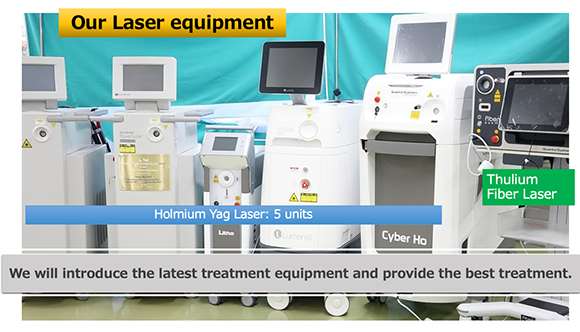
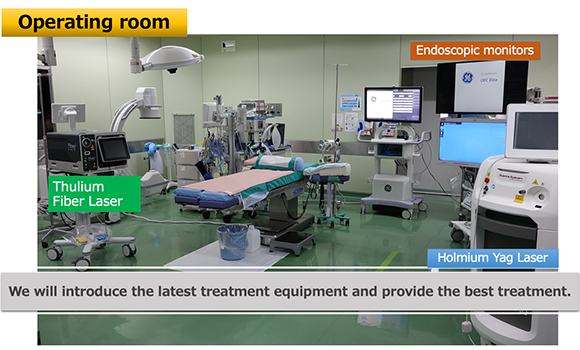
Endoscopic Urinary Stone Lithotripsy
Urinary stone lithotripsy (for kidney and ureteral stones) can sometimes be very painful.
For this reason, our department recommends early hospitalization and surgical treatment.
We are committed to minimizing pain during and after surgery.
Specific Measures for Postoperative Pain Management
- Anesthesia is administered by three board-certified anesthesiologists.
- For urinary stone lithotripsy, general anesthesia, epidural anesthesia, or combined spinal-epidural anesthesia may be used.
- For ureteral stent placement, spinal anesthesia administered by an anesthesiologist is performed.
- For male patients, we actively use flexible cystoscopes (soft bladder cameras).
- To reduce catheter-related pain after surgery, epidural tubes (continuous anesthetic infusion) are actively used until the following morning.
- For male patients, we actively use urinary catheters combined with local anesthesia.
- When removing postoperative ureteral stents, flexible cystoscopes (soft bladder cameras) are used in all cases.
Thulium Fiber Laser (TFL)
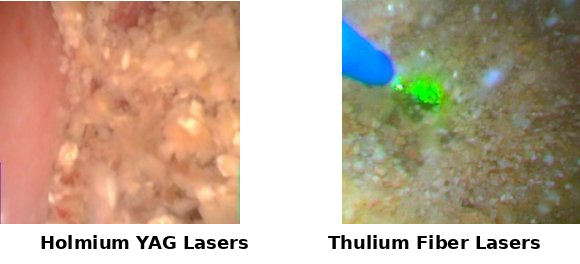
- Compared with conventional lasers, stones can be fragmented into much finer dust-like particles.
- It enables treatment of larger stones in a shorter amount of time.
- By combining it with a Holmium:YAG laser, treatment can be performed safely and efficiently. (Certain conditions are required for use. Please consult your physician for details.)
Benign Prostatic Hyperplasia (BPH)
Our department offers
three surgical treatment options for BPH.
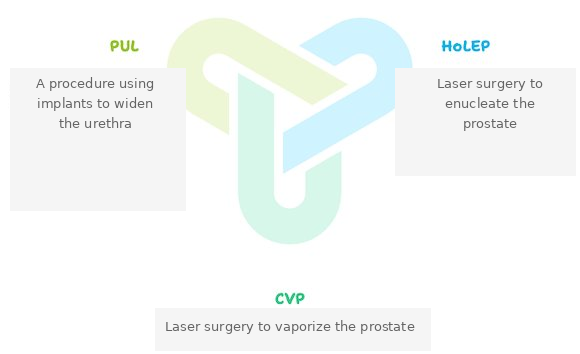
- HoLEP: A procedure that removes enlarged prostate tissue using a laser.
- CVP: A procedure that vaporizes prostate tissue using a laser.
- PUL (Prostatic Urethral Lift): A procedure that widens the urethra using implants (small wires placed in the prostate).
The most appropriate procedure will be recommended by your physician based on the size and shape of your prostate, physical condition, and bladder function. Please watch the videos on our website for more details about each surgical procedure.